

Introduction to Mind Mapping: A Creative Tool for Organizing Thoughts
In today’s fast-paced world, information overload can often leave us feeling overwhelmed. Whether you’re brainstorming for a project, organizing study notes, or planning your next big idea, keeping your thoughts structured can be a challenge. This is where mind mapping comes into play. It’s a simple yet powerful visual tool that helps you organize, connect, and structure your thoughts in a way that is both intuitive and creative.
What is a Mind Map?
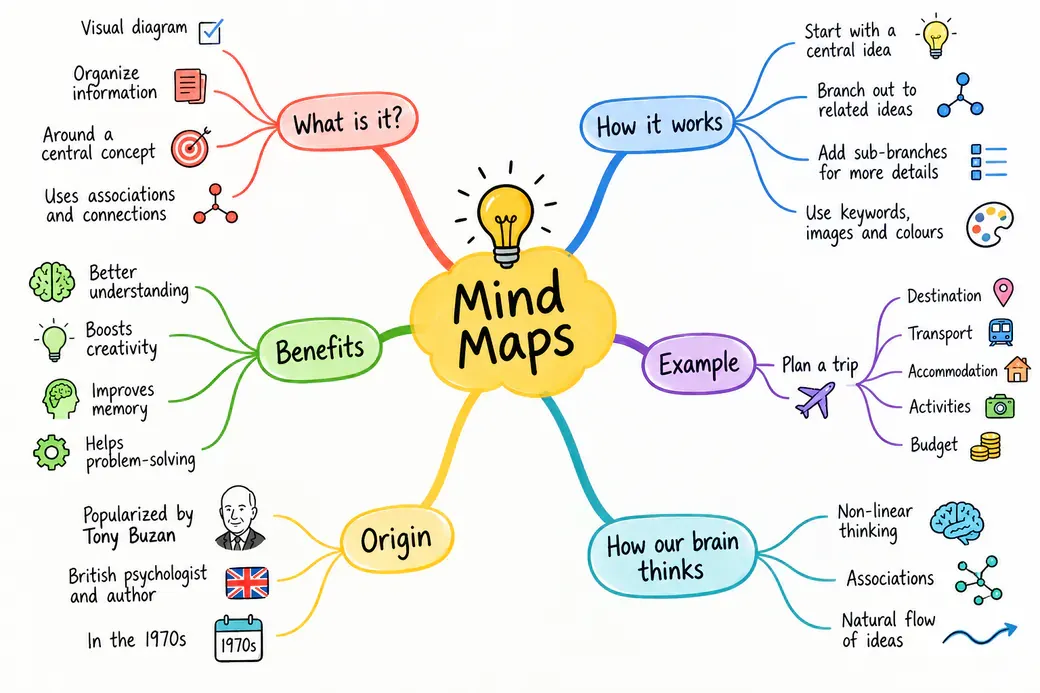
A mind map is a diagram used to visually organize information around a central concept. It mimics the way our brains naturally function, using associations, connections, and radiating lines. Tony Buzan, a British psychologist and author, is credited with popularizing mind maps in the 1970s. He saw the mind map as a reflection of how our brains process and connect information non-linearly.
At its core, a mind map begins with a central idea, and from that central point, related ideas branch out. Each branch can have sub-branches that explore more specific aspects of a topic. It looks almost like a tree, with ideas growing organically from the trunk (central idea) into branches (main points) and smaller branches (subtopics).
Benefits of Mind Mapping
- Enhanced Creativity and Brainstorming: Mind mapping encourages free-flow thinking, helping to unlock creative ideas that might otherwise remain hidden in a more structured, linear format like lists or outlines.
- Improved Memory Retention: The visual and spatial nature of mind maps engages multiple regions of the brain, making it easier to recall information later. Studies have shown that the use of colors, images, and connections in mind maps aids in memory retention.
- Simplifies Complex Information: Mind maps break down complex topics into manageable chunks, allowing you to see the bigger picture while understanding the details. By showing relationships between ideas, they help clarify connections that might otherwise be missed.
- Fosters Collaboration: In team settings, mind maps can serve as a collaborative tool, making it easier for everyone to contribute ideas, spot patterns, and see how various concepts relate to one another.
How to Create a Mind Map
Creating a mind map is straightforward and adaptable to different needs:
- Start with the Central Idea: Place the main topic or concept at the center of the page. This could be the subject of a presentation, a project, or even a problem you're trying to solve.
- Branch Out with Key Concepts: From the central idea, draw branches outward, each representing a major theme or important idea. Use short phrases or keywords for each branch.
- Add Sub-Branches: For each key concept, think about supporting details, related ideas, or specific examples. Add these as sub-branches connected to the main branch.
- Use Colors, Images, and Symbols: Mind maps are most effective when they engage multiple senses. Use different colors for different branches, incorporate symbols, and add images that reinforce key ideas. This makes the mind map more engaging and easier to understand.
- Refine and Connect: As your mind map grows, you might see relationships between different branches. Feel free to draw lines connecting them. The beauty of a mind map is its flexibility, so don’t be afraid to make changes as your understanding evolves.
When to Use a Mind Map
Mind mapping is versatile and can be applied to a wide range of personal and professional scenarios:
- Brainstorming Sessions: Whether alone or with a group, mind maps help free-flow brainstorming by visualizing ideas and connections.
- Project Planning: Organize tasks, set priorities, and break large projects into smaller, manageable parts.
- Note-Taking: For students or professionals, mind maps are an excellent tool for summarizing key points during lectures, meetings, or while reading.
- Problem Solving: Mind mapping can help clarify complex problems by identifying core issues and exploring potential solutions.
- Goal Setting: Map out your goals, identify steps to achieve them, and visualize possible obstacles.
Digital vs. Hand-drawn Mind Maps
Traditionally, mind maps are hand-drawn on paper, but with the rise of digital tools, there are now many software solutions like XMind, MindMeister, and SimpleMind that make it easy to create, edit, and share mind maps. While hand-drawn maps offer the benefits of tactile engagement and free-form creativity, digital mind maps come with the advantage of easy modifications, collaboration, and access across multiple devices.
Conclusion
Mind mapping is a highly adaptable and powerful tool for organizing thoughts, enhancing creativity, and improving memory retention. Whether used for personal growth, project management, or academic purposes, mind maps offer a dynamic way to visualize and structure information. By engaging both the logical and creative sides of your brain, mind maps empower you to think more clearly, solve problems more effectively, and unlock new possibilities.