

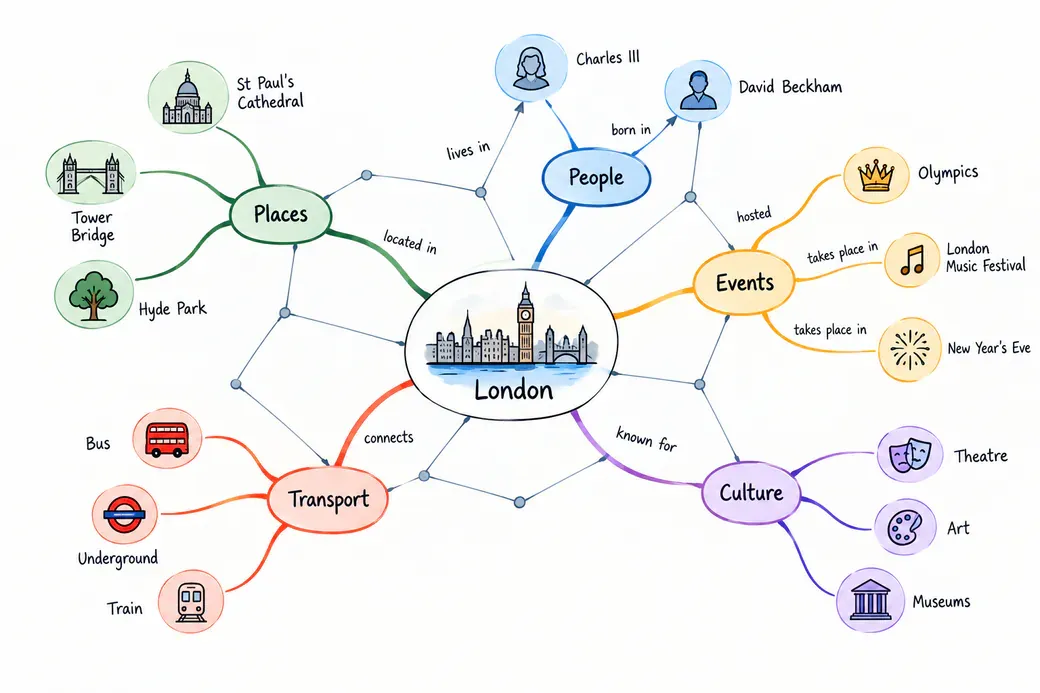
Combining Mind Mapping and Knowledge Graphs: A Powerful Approach to Organizing and Connecting Ideas
In an age where information is abundant but often overwhelming, finding effective ways to organize, visualize, and connect ideas is essential. Two popular methods, mind mapping and knowledge graphs, both serve this purpose in unique ways. But what if we combined these two approaches? Doing so can unlock new possibilities for deeper insights, better organization, and more intuitive ways to work with complex information.
Benefits from Mind Mapping
Mind mapping bring a visual technique for organizing ideas and concepts. It starts with a central idea and branches out into related ideas, mimicking how the brain naturally works. It’s a great tool for brainstorming, planning, or simplifying complex topics. Mind maps encourage free-flowing thoughts, using colors, shapes, and symbols to represent concepts and their relationships.
- Key Features:
- Central idea with branching sub-ideas
- Use of colors, symbols, and images for visual clarity
- Focus on creativity and quick idea generation
Benefits from Knowledge Graph
A knowledge graph, on the other hand, bring a structured representation of data where pieces of information (nodes) are connected by relationships (edges). It’s not just about individual facts but about showing how those facts are related, allowing systems to understand data contextually. Knowledge graphs are typically used to model complex domains, enabling machines to process and understand information more intelligently.
- Key Features:
- Nodes (entities) connected by edges (relationships)
- Structured, formal data model (often using ontologies)
- Designed for data integration and contextual understanding
How Mind Mapping and Knowledge Graphs Complement Each Other
Both mind mapping and knowledge graphs focus on relationships between ideas or data points. Mind maps are intuitive, flexible, and creative, making them ideal for brainstorming and idea generation. Knowledge graphs, on the other hand, are more formal and structured, which makes them ideal for organizing large datasets and connecting complex information.
By combining the flexibility of mind mapping with the rigor of knowledge graphs, you can create a system that’s both highly creative and deeply structured. This hybrid approach enables you to capture initial ideas freely and then gradually organize them into a more formal, data-rich model.
Benefits of Combining Mind Mapping with Knowledge Graphs
- Enhanced Creativity and Structure: Mind mapping’s creative approach helps you generate ideas quickly and organically. As you expand on those ideas, knowledge graphs can help you structure them in a way that reveals deeper connections and patterns.
- From Brainstorming to Data Organization: Start by using a mind map to brainstorm and freely explore ideas around a central topic. As the map grows, you can refine it into a knowledge graph, adding more structured relationships, data types, and formal ontologies. This helps move from free-thinking to organized, actionable insights.
- Improved Problem Solving: Mind mapping helps break down a problem into smaller parts, making it easier to tackle. Once you have a better understanding of the issue, a knowledge graph can show more complex interconnections, helping you see solutions that aren’t immediately obvious.
- Contextualized Learning: Mind maps are great for quickly capturing knowledge, while knowledge graphs provide a deeper layer of understanding by linking concepts in a meaningful, contextual way. This combination is especially useful for learning and research, where you need to absorb large amounts of information and understand how different pieces fit together.
- Better Decision Making: When planning or making decisions, mind maps allow for quick idea generation. The knowledge graph component can add a layer of analysis by showing relationships between factors, allowing for data-driven decisions with clearer context.
- Collaboration: Both mind maps and knowledge graphs are great collaborative tools. Mind maps allow team members to freely contribute ideas, while knowledge graphs can help organize and validate those ideas by showing relationships and dependencies. This leads to more informed, structured team discussions.
Practical Use Cases of the Hybrid Approach
- Project Planning: Start with a mind map to brainstorm project tasks, ideas, and goals. As the project evolves, transform the mind map into a knowledge graph to organize tasks based on dependencies, resources, and timelines. This gives you a clear view of both the creative process and the logistical side of the project.
- Research and Learning: When diving into a new subject, use mind mapping to outline key concepts, sources, and related ideas. Once you’ve gathered enough information, build a knowledge graph to visualize how different topics are connected, enabling deeper insights and the discovery of hidden relationships.
- Content Creation: Writers and content creators can use mind mapping for brainstorming ideas and outlining topics. As the project progresses, a knowledge graph can organize themes, subtopics, and references, helping to ensure consistency and coherence across the content.
- Business Strategy: Teams can use mind maps for strategic brainstorming sessions, then use knowledge graphs to connect various business factors—such as market trends, competitors, customer needs, and internal resources—allowing for more informed, holistic strategies.
- Personal Knowledge Management: Individuals can use a combination of mind maps and knowledge graphs to manage personal information, from learning new skills to organizing hobbies or work-related tasks. Mind maps help quickly capture ideas, while knowledge graphs ensure everything is connected and easy to retrieve later.
Conclusion
By combining the creative freedom of mind mapping with the structured insights of knowledge graphs, you get the best of both worlds—flexibility for brainstorming and rigor for organizing and analyzing complex information. Whether you’re working on a project, learning a new subject, or managing data, this hybrid approach offers a powerful way to structure your thoughts and turn them into actionable insights